Whatever happened to vaporwave (and should it happen again?)
Like anyone prone to fits of neurotic misery I often find myself ruminating on the past - on lost time, on missed chances, on bygone eras from which I failed to squeeze all the lifegiving juice. I can't say why I often slide back into this definitely unhealthy "completionist" mindset about real life, an experience which categorically cannot be one-hundred-percented (maybe it's some sort of undiagnosed mental disease). In any case, FOMO is a bitch. I make a conscious effort to shoo away nostalgia whenever it creeps into my head - I don't think it's a very productive emotion - but I also wonder if this corrosive feeling of grief for things past can be rightfully called "nostalgia", or if it is instead nostalgia's more alien cousin which I cannot name, but I figure must be some species of regret. What if I had lived more? Lived sooner? Our window of existence on this Earth is finite and Father Time is a real tease.
The past mocks you a little, I think. It's scintillating and unobtainable and behind your back, at some point, the you who lives there became an eerie stranger. I know I'm not the only one who's experienced this feeling because vaporwave captured it and ran with it throughout the 2010s. Nostalgia is framed frequently as a sort of comfortable, rosy ambrosia. What about nostalgia-as-enemy? That's the area where vaporwave thrives.
Let's establish now what we're talking about when we talk about vaporwave, before we get too deep in the weeds: I mean vaporwave as a sincere artistic movement, the vaporwave which existed somewhere between its beginning as an ironic, jokey experiment and its end as a shallow, equally jokey aesthetic - or in simpler terms, "after vaporwave being a bit, but before it being cool". I'm talking about the Middle Kingdom of vaporwave, where the people making it earnestly called it "plunderphonics" and all the really influential records from people like Vektroid and Blank Banshee dropped. I mean the period where vaporwave microlabels proliferated like nukes across Bandcamp and people took it seriously. Maybe the period I'm referring to doesn't exist at all. I don't know.

I do know, for sure, that I took it seriously. Vaporwave heavy hitters like 2814's Birth of a New Day and Blank Banshee's Mega were dropping as I entered high school and/or college1 and I soaked myself in the scene. I was on Reddit collaborating with vaporwave musicians and authors to make cover art for their projects, I was making vaporwave video games in Skype groups with people across the planet, I was collecting albums no one had heard of on my hard drive and teaching myself to use free software like Audacity and GIMP which which I might steal and repurpose bits of the past for my own teenage designs. It was a free ecosystem if ever there was one, and it was teeming with life.
More than anything I recall the people that I met. It's true that immersing yourself in any artistic movement or scene is a great way to meet interesting people, but vaporwave was astounding in the sheer variety of folks whose interest it pulled. Some fascinating, creative individuals I cannot forget:
- b4byf4c3, an experimental musician for whom I did vaporwave album art. Though he dabbled in vaporwave under a different alias, his primary genre was chipthrash, which was utterly new and fascinating to me. He introduced me to some really out-there acts like the penis-nosed chipthrash DJ Anklepants, and also kept me appraised of his multi-year-long attempt to film a series of Jackass-esque videos with his friends.
- Shaun Gavin, a filmmaker who contacted me after using screenshots of my LSD: Dream Emulator-inspired game Dead Sky in a short video he made for an art exhibition, called Space Zoo. We ended up talking extensively about life, Jodorowski's Dune, and a really detailed pitch for a satirical video game adaptation of Lovecraft's The Shadow over Innsmouth.
- holy$wagg, who commissioned me to do the cover for a vaporwave book entitled Vape Girl. Vape Girl is a sort of gonzo stream of consciousness novella which I'm pretty sure is lost media at this point, except no it isn't because I still have a copy. Ultimately my cover was not used but it was still a singular experience working with this person, who seemed to be living in a different dimension.
- A Russian trans girl, my age at the time (16), whose name I never learned but who allowed me to use some of her keyboard sketches as part of the soundtrack for Dead Sky. We met in a Skype group for a vaporwave record label which I did the logo design for (sadly it never got off the ground). She sticks with me the most. She just disappeared one day, dropped right off the face of the Earth. I no longer have access to my old Skype, nor her socials, nor any of the files she shared with me. The only scrap I have of her now is a single track which has a random chance of playing during exploration in Dead Sky. It is a wistful sequence of keyboard notes which I can pull from memory instantly, always. I hope she's doing okay.
That last one is part of what set me off writing this post in the first place. You've probably heard this word enough for several lifetimes by now, but: walking around in Dead Sky, a game I scarcely remember making a decade ago in my parents' basement, and hearing that one snippet of someone I'll never know again is haunting - it is surreal - it is downright... liminal.

Towards the end of the '10s, vaporwave, its spinoff genres, and the nostalgia-as-enemy zeitgeist culminated in the mass discussion of "liminal spaces." Suddenly, everyone's new favorite type of horror was all about the familiar turned topsy-turvy and hostile. We all agreed that empty movie theaters and shut-down Chuck E. Cheese's and certain areas of Super Mario 64 oozed an uncanny wrongness that beaded and settled in the parts of our minds which uncomfortably dwell on the past. Sure, some people claimed to like liminal spaces in the same way there's always some freak that's like, "Ooh, I just love the smell of gasoline," and that's fine, whatever floats your boat - but overall, as the decade came to a close, the detached, satirical, skeptical environment which birthed and fed off of vaporwave spit out "fear of liminal spaces" as its final pearl. Vaporwave had burned out like an old lightbulb, lived its last gasp as a trendy aesthetic, and left behind a tangentially related thesis: the past is a fucked up, wrong, empty place full of things that will get you, lurking just out of sight.
As if on cue, the next decade immediately opened with a global pandemic that turned every real place into a fucked up, wrong and empty version of itself, and the political turmoil which followed turned everyone you used to know into someone that was out to get you. Halfway into these rawring '20s, the mother of all liminal spaces - the most famous online urban legend since the Russian Sleep Experiment - was turned into a wildly popular feature film by writer Will Soodik and up-and-coming genius toddler director Kane Parsons. That's right: I'm talking about the Backrooms.2
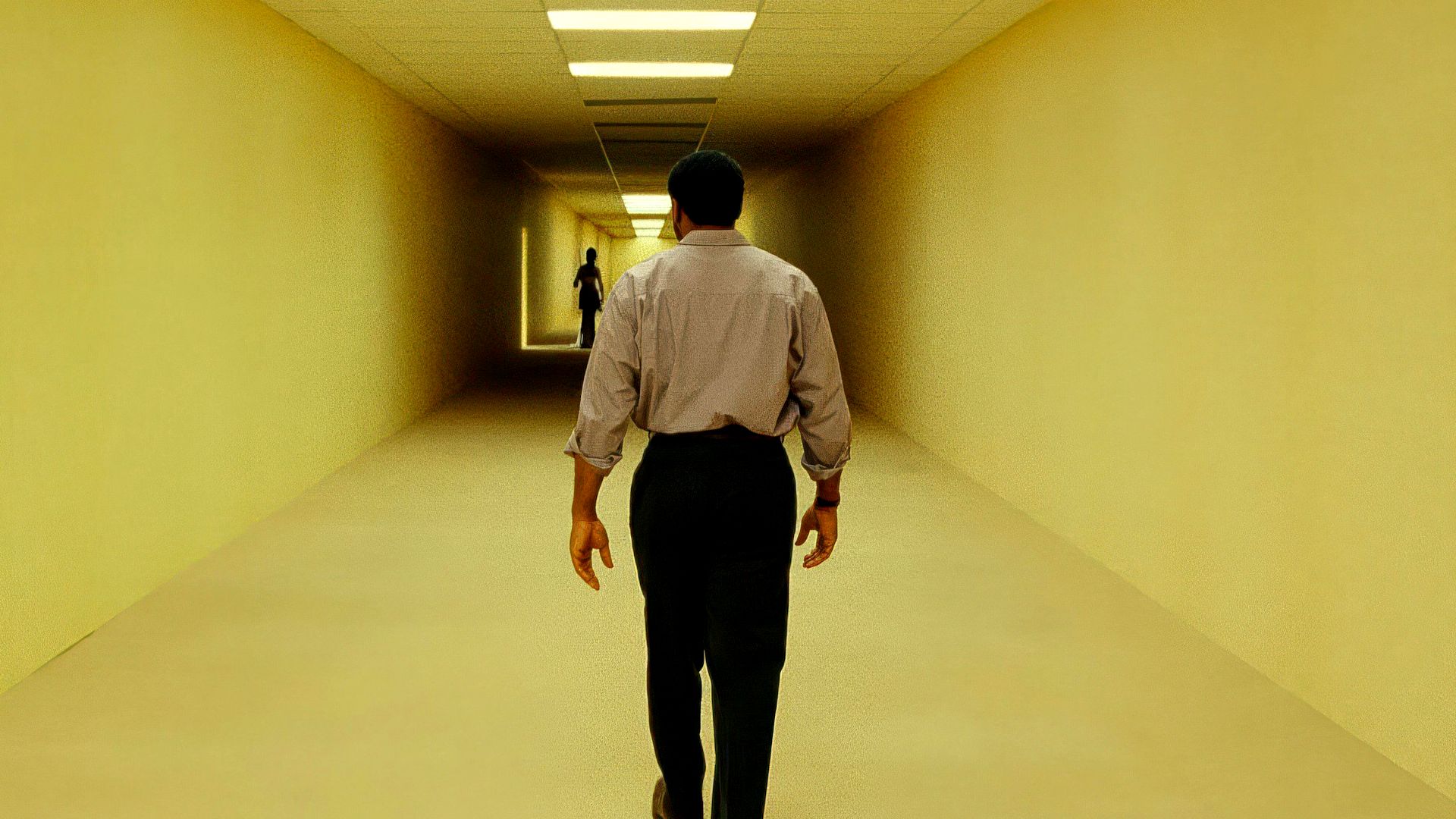
Soodik and Parsons' version of the Backrooms are, critically, not a traditional mythical purgatory or a genius loci or any other sort of twisting dreamspace which adapts to and tortures the film's protagonist, Clark, with dark manifestations of his psyche. They just exist. They are alive (or perhaps half-alive), but they are solid, they are mappable. It is critical that they just exist and possess no agency or intent. Clark does not get sucked deeper and deeper into them by some siren-like draw; indeed, the fault lies solely with Clark for repeatedly entering them, for feeding people and time and his own scant potential for personal development into them willingly, because he finds them comfortable. Even the literal scary monster which lives in the Backrooms and eats people is Clark, is a degraded version of Clark with far less agency than him. Nothing in that un-place is really out to get you. It's your choice when you hand things over to it.
Clark is a guy whose entire identity revolves around being stuck in the past, a guy made of FOMO and regret and enemy nostalgia who blames every missed exit in his life on other people. His immersion in that non-place, his twisting himself away from the future to find comfort in an alien past, is a prison he's moving into entirely on his own. By the dinner scene, when he's moved in all the way, things start to veer into camp. The film revolves around a thesis more complex than that of the liminal space: entering the nowhere-zones of the past in search of comfort is more than a freaky mistake - the very notion of attempting to do so is absurd. It is so impossible that it becomes black comedy. The past is a real and mappable space, but it extends further backward behind us every second. Each time we remember and re-remember it, we remember something faker and faker, something more and more counter to any reality that ever was. If you're trying to move any direction but forward, you may as well be noclipping out of reality wholesale. Like the goons at A-Sync and like Clark and even like Mary, you dip your toes into this space because you are chasing a hand-me-down purpose which no longer applies to you. Whether or not you are self-aware, you are ultimately opting in to being stuck.

I think my own nostalgia is absurd. I know it is, because I'll spend a given year wishing things were a bit better like they were a few years before, and then when some years have passed, I'll look back on that year and it seems all shiny and grand. I think my regret is absurd because I know that I have always tried my best to play the cards I have, and the things in my life that are good and right could not have been achieved a second sooner without outside help or dumb luck (or if they could have, regret won't change it now). I know the whole cycle is absurd, I know my mind's own rose-tinting of current-year-minus-x is downright goofy. It has to be some kind of gross cognitive dissonance.3 Nonetheless, this splinter in my heart persists.
It should be said that no emotion is bad. No thought is bad. Like Soodik and Parsons' Backrooms, the mind just is. References I have made here to my own emotions as unproductive or absurd are more informed by my own tendency to be dismissive of myself than by any objective value or lack thereof certain emotions might possess. Emotions just exist. Maybe you believe, as I try to, that they exist to be expressed. After all, failure to express emotion is painful, corrosive, and deleterious to the self. We all gotta get our yayas out somehow. Everyone does it differently. Some do it through art.

The internet is always chock full of a thousand blossoming artistic microscenes and it feels like at least half of them are about expressing nostalgia for a sequence of bygone decades. The once-ubiquituous synthwave jerked off really hard and loud about the '80s and kept snowballing until we ended up with bloated, multi-year projects like Stranger Things and the aborted sequel to Kung Fury. Now, the revival of Frutiger Aero yearns for the utopian technologist designs of the 2000s, yet another new "better time" that's long gone but still sticking sharp in everyone's hearts. Vaporwave stands out to me as something unique, in that it was on paper a similar revival of the '90s, but in practice a skeptical reexamination of them and of nostalgia itself.
Vaporwave does not depict the past as a blanket you can wrap around yourself. Like the movie Backrooms (which is, by my estimation, a post-vaporwave work of art), it treats the nowhere-zones of an imagined past as alien, impossible, fascinating, and laughable. In doing so, it creates something altogether new. Nostalgia isn't wrong - no emotion is - but when expressed artistically, it leads to at worst the making of copies, and at best a fun revival or two.
Sometimes a revival is great (I for one am happy to see grunge coming back because I like the sound of grunge4, I thought the first season of Stranger Things was well done, etc.), but it's a dead end, you know? Until digging up the past yields material for building the all-new, all-different future, it's just a carousel of graverobbing, homage and pastiche. You can have a lot of fun with that, but I don't think you can build a future on it. If we want to move forward, we have to be in conversation with the past, and I think it should be a tense conversation, too. We can't let ourselves trust that guy further than we can spit, or he'll take a bite out of us. Chomp!
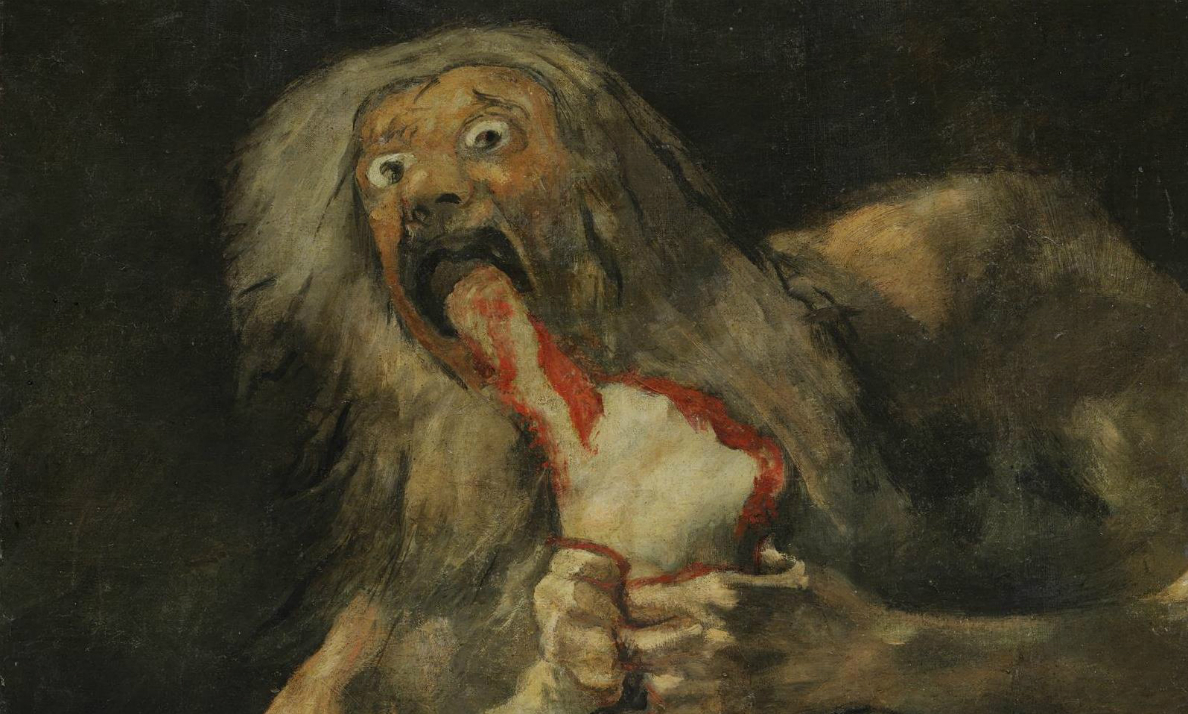
When I started this article I was mourning the loss of vaporwave. Honestly, I was mourning the loss of me-during-vaporwave. "How cool was it," I thought to myself, "to be immersed in a new artistic movement on the cutting edge, to be surrounded by people doing something fresh and to do fresh things with them." The truth is that there is little to mourn, and vaporwave wouldn't want me to. Take a look at box-office flops like this year's Masters of the Universe. Everyone is absolutely, loudly, openly sick and tired of nostalgia. You can't sink your teeth into this stuff. You cannot digest and be nourished by a recycled past.
What I am mourning, then, is a period of time where it felt possible to chow down with strangers at a shared creative table, to gorge myself on an artistic movement that was distinctly counter-nostalgic. New things were born when a group of people all came together and agreed to take that shard which the past sticks in your heart and wield it instead of just nursing the wound. Vaporwave should never happen again, that'd be sacrilege - but if something like it doesn't happen soon, I think we're all going to starve.
High school and college heavily overlapped for me because I am a brain genius. Ladies, one at a time, please.↩
To clarify, the Backrooms as per 2026 internet culture are their own thing I don't know much about, basically equivalent to a quirky collaborative fiction megadungeon. In this post I am specifically talking about the movie Backrooms, which was based on Kane Parsons' Backrooms webseries, which was based on the original creepypasta and nothing else.↩
That or my life is just actually deteriorating over time, but I don't think that's true - for one, I don't have to wear skinny jeans or see pictures of James Charles anymore, so things can't be all that bad.↩
Torus, for example, did a fun cover of Billie Eilish's "Ocean Eyes".↩