Searching for the free games ecosystem (and designing for desire paths)
Coming home from an absolutely legendary (and mercifully affordable) thrift haul I began to think about how brokeness influences the development of taste. About a month ago my only pair of sneakers, an absolutely disgusting pair of low top white AF1s, blew out while walking back and forth in rainy Portland. My saving grace was the only other pair of shoes I own: these standard issue Swiss Army boots.1

The reason I bought these boots is because milsurp is often cheap, and I needed cheap boots that would last me a long, long time - not fashion boots, like Doc Martens. Similarly, the reason I bought the Forces is because I needed a durable, comfortable pair of sneakers and I got lucky enough to lowball a used pair on eBay. Were I flush with cash, I might be the sort of Sex and the City-ass woman to have a closet full of shoes, a pair for every occasion - but I am not flush with cash, nor have I ever been. This means that I have built my outfits, always, around one pair of sneakers for sneaker weather, and one pair of boots for boot weather. Shoes are the anchor which hold an oufit down and tether it to a single idea. Like my shoes, most of my outfits are used.
Almost all of my clothes have been used for my whole life. As a child I wore and loved thrifted and hand-me-down clothes. Thrifting became a hobby of mine as a listless teenager in the late '10s, when things like normcore and workwear and dressing up like Mac DeMarco were in vogue, meaning that, for once, something stylish and current was accessible to me. I still thrift most of my clothes and thus my tastes gravitate toward thriftable looks like futchy grunge and old hag fashion. There is perhaps a universe where I am a goth or a streetwear aficionado or a fan of nice suits, but those are looks for people with the funds to pursue them. My taste is steered by my material conditions. When my sneakers broke in Portland and I was forced to always wear boots, I began to find new life in things from old boxes.
Suddenly a too-short pair of wide-legged jeans looked less awkward and more attractively cropped with tall boots brushing just against the hem.
Suddenly a boxy, overbearing wool coat I'd thrifted to survive my first cold winter in half a decade stopped being unwieldly and became the perfect complement with big, clompy footwear in the picture.
Suddenly a hand-me-down reversible belt I'd only ever considered wearing brown side out looked great in black (after all, you can't go wrong matching your belt to your shoes).
Limited access, limited choice, was forcing my taste to evolve in an unexpected direction, forcing me to appreciate things which I had previously overlooked by finding paths of least resistance towards outfits which met my needs. So, a thesis: BEING BROKE CREATES DESIRE PATHS. How does this tie into games? Good question.2 Walk with me down memory lane, and enter Cave Story.

If you care about video games at all, especially indie video games, you have heard of 2004's landmark freeware game Cave Story. It's an excellent Metroidvania which has since been licensed, retranslated and remastered several times by Nicalis, and ported faithfully to every system under the sun by its dedicated fans. In its freeware form, Cave Story stuck with me and permanently altered the trajectory of my taste. Now, I don't have anything new to say about it, so I won't. The praises of Cave Story have been sung a million times over by better writers than me. This isn't about Cave Story, this is about how I found a formative, tastemaking piece of independent art like Cave Story - and I found Cave Story thanks to a little freeware game site called caiman.us.
I'm going to be real: I have no idea why caiman.us exists and I don't even remember how I found it. In the haze of my childhood memories, it simply always existed, perpetually daring me to plunge its depths via library computer, to load up my 2 GB thumb drive with dazzling and unusual freeware and take it home to my family computer which did not connect to the World Wide Web. According to the announcement on its homepage, its founder, Rudy Versele, has been dead for sixteen years at this blog post's time of writing, and whoever runs it now has been "still in the process of figuring out about the update software" (?) since the early years of the Obama administration. It has always been riddled with ads, and (if my parents were to be believed), riddled with viruses too.
Most of the titles available on caiman.us are curious, rough-hewn little oddities I've never heard of anywhere else - ain't nobody out there playing Sonic Death Zone, Tennis Antics, Lost Dutchman Mine 3D, Super Mario PC Fun 2, or Thang Global3 - but that just adds to the charm. Every one of these games, sourced from developers all over the web, comes with a handwritten, personal note from Rudy or another member of the site's staff. Caiman.us is curated chaos. It is the mom-and-pop thrift store of PC games. In this artificially intelligent, push-button age, you might say that the commentary on caiman.us has a human touch. For instance:
Super Mario PC Fun 2 is a collection of 9 minigames in a RPG environment. In my opinion there are more than 9 games in it.
There may well be more than 9 games in Super Mario PC Fun 2, I don't know Super Mario PC Fun 2 from Adam - but I do know that I trust what Rudy tells me, because he sat down to play Super Mario PC Fun 2 and make his judgement call. That's a human touch.

In addition to caiman.us' more obscure titles, some real indie OGs are tucked away in the Caiman catalogue, such as Derek Yu's iconic roguelike Spelunky, influential cult classic platformer N, and long-running Doom-powered Sonic fan project Sonic Robo Blast 2. Along with Cave Story, these buried gems stuck with me, they changed me, and despite their legendary status among seasoned indie game fans, my ten-year-old Bazooka-chewing ass only found them because BEING BROKE CREATES DESIRE PATHS.
Unlike my better-off peers who were able to access the latest Xbox 360 or Nintendo DS games, all I had was a crusty old family PC and two library computer lab hours per week to scrounge for interactive entertainment. Caiman.us was my path of least resistance, and that path of least resistance shaped who I am today. Caiman.us wasn't the only place my desire paths led.
Thanks to the YoYoGames Sandbox (a now-defunct but thankfully archived database of projects created using Game Maker), slayer64's Mega Block Man 2 introduced me to programming fundamentals, the joy of the level editor, and MIDI renditions of various Gorillaz songs4. Also on YYG Sandbox: the early work of Allison J. James, FKA "NAL", who instilled in me the value of polish, simplicity and, yes, a certain type of swag. She's still going wild with fonts and shit, over at Chequered Ink, to this day!
Through Game Jolt I stumbled upon fascinating indie games like Bernband, Imscared: A Pixelated Nightmare, and Manos: The Revenge of Torgo.5 I'm not sure what's up with Game Jolt these days; at a quick glance it seems to be having an identity crisis that's splitting its attention between visions. Is it a modern storefront, a creator/fandom social network a la DeviantArt, or the simple indie game hosting site it used to be? In many ways, itch.io, once Game Jolt's strange, woke son, has stolen the Mandate of Heaven and eaten Game Jolt's lunch. Nonetheless, there was a time when Game Jolt was the place to be for downloading free indie games rich with vision, courage, and heart.

Together, sites like these formed a media underlayer, a scavenger's dreamworld of endless free games, endless inspiration made more or less by random people. In the interest of brevity, I've elected not to discuss the parallel underlayers of free Flash game sites like Newgrounds - bountiful on the Web in their heyday - or aggregator sites like Softpedia and Softpaz, whose staggering, presumably scraped libraries scare me a little6. Deep diving those is best saved for another article.
There's something else we're neglecting to examine, though: you can't talk about free games without talking about transgressive and transformative play. "Free games on the internet" describes something much greater than games literally intended to be free - it also necessarily describes the ubiquitous practices of altering, breaking, stealing, and hoarding games that were never meant to be free, and the vibrant communities which form around these illicit activities. Follow the DESIRE PATHS OF BROKE PEOPLE and enter emulation, homebrew, and modding.
When I would scavenge for free games on the library computer, emulation was a primary and urgent interest, and two of my favorite sites to visit were CoolROM, a frankly ancient ROM repository site which seems to have been gutted over the last decade, and the offbeat internet humor site SydLexia.com. Internet funnymen Syd Lexia et al. introduced me to games I would absolutely not have discovered otherwise, like the NES body horror shmup Abadox: The Deadly Inner War.

Abadox, a joint production of Mattel and Natsume, starts with a fairly standard science fiction premise and wows with art direction entirely unlike its contemporaries. Per Wikipedia:
In the year 5012, the planet Abadox is eaten by a giant alien organism known as Parasitis. Having consumed Abadox, the alien takes the form of the planet and seeks to devour other planets. The galactic military launches an attack but is destroyed by Parasitis who goes on to devour the hospital ship carrying Princess Maria. Second Lieutenant Nazal, the only surviving fighter of the galactic fleet, attempts to enter Parasitis's body and rescue Maria before it is too late.
Abadox is a weird game. Where other NES shmups would have you fly through the interiors of asteroids and battle enemy ships or the occasional Gigeresque alien, Abadox insists upon pitting you against fleshy, pulsating organs, viscerally unappealing parasites, skinned animals, and more. It was one of the first games I emulated, and it lodged a question in my brain: how many more weird, free games were out there, buried in the dutifully ripped and uploaded ROM libraries of consoles way before my time? I learned to walk the desire path of emulation, of video game preservation, of video game history. I couldn't play the new, expensive hotnesses like Call of Duty: Black Ops or Pokémon HeartGold and SoulSilver. I had to play shit like Abadox, and I loved it.
My learned appreciation for emulation and retro gaming stuck permanently, still going strong in my early adulthood. Some of my fondest memories in college have everything to do with free gaming. There was one semester where my friend John and I would routinely show up an hour early to our first class of the day (Introduction to Web Design) with USB controllers and a flash drive containing a portable SNES emulator. It was always deserted during that first hour of the day, and that meant we got to hijack the teacher's computer and play Street Fighter II on a giant projector every morning. Like my limited access to clothes determining the way I learned to love to dress, my limited access to video games sent me down the desire path of doing something transgressive, memorable, influential to my development of self. I never appreciated fighting games before that year; now I can sit down and play one any time, with any person at all7.
In fact, free, emulated games were a social staple at the college house parties I attended: our friend Betsie had a jailbroken OG Xbox packed to the brim with full ROM libraries of just about every system that thing could handle. Free games create DESIRE PATHS TOWARD A MEDIA THIRD SPACE. You don't have to pay to play Samurai Shodown, Fatal Fury Special, or Mortal Kombat II with a perfect stranger at Betsie's house. The jailbroken Xbox takes care of it all for you, and limited access to the world of paid gaming pushes us toward the unlimited possibilities to be found in ROM libraries. Jailbreaking a console to run homebrew is one of the best things you can possibly do for your soul. It is like freeing a nervous, abused horse and sharing a special moment, a special bond with it only a horse and a weird girl can have. After experiencing naughty Street Fighter II with John and the bottomless fun of Betsie's jailbroken Xbox, I went home to jailbreak my Wii, and once I had unrestricted access to every WiiWare and Virtual Console release available, I got really into The King of Fighters.

KOF is great because it's like Street Fighter's gay, weed-smoking cousin. The milieu around KOF is heavy with the scent of emulation, bootlegging, and piracy, and in fact KOF's notorious popularity in Latin America can largely be traced to desire paths formed as a result of material conditions. From Kotaku's article "Why King Of Fighters Dominates Latin America’s Fighting Game Scene":
The Neo Geo platform that the games ran on was essentially a cartridge-based console for arcades. While it looked like a standard arcade cabinet, Neo Geo ran its games from cartridges that could be easily swapped out by an arcade owner. This meant that upgrading to the latest, hottest game was simply a matter of spending a few hundred dollars on a new cartridge, not thousands on a new machine. And arcade owners could pass that savings on to the consumers when it came time to put in their 25 cents—or their 50 centavos.
In Latin America in the ‘90s, this meant that Neo Geo was nearly always the better alternative. Moreover, kids were more likely to play games on arcade machines than home consoles. While Nintendo and Sega did have a presence in Latin America during this period, high tariffs on the Super Nintendo and Sega Genesis meant that they were often priced out of the range of the average consumer. Part of the reason for these upcharges was Mexico’s history of black- and gray-market console piracy. Video Games Around the World, published by MIT Press in 2015, discusses how US-Mexico border cities were the primary places in the 1980s where gaming consoles could be obtained, with mostly bootleg merchandise trickling southward.
While I wasn't growing up in '90s Latin America (try '10s Wisconsin), I still found the colorful history of KOF enchanting, and like many free games that open the door to free fun, it had colorful documentation in wiki form. I properly learned how fighting game inputs work by studying the now-defunct SRK Wiki, which not only taught me skill, but also loads of super interesting facts about KOF's cast of characters.

I believe that game wikis are a type of transformative work, and freely available transformative work is equally important to the world of free games as transgressive work like piracy and emulation. Creating documentation and tools for jailbreaking consoles so that broke children (or adults) may enjoy unlimited free games is, in its own way, transformative work. Every Wii LetterBombed, every PS2 FreeMcBooted, transforms a defunct console from a relic of a specific commercial era - whose utility past its prime is at the mercy of capricious used game collectors' markets - into a veritable wonder-engine of singular purpose: more game for free.
Keep in mind, though, that the fundamental directive of "more game for free" isn't just something accomplished through hardware hacking - it's also the driving force behind the simultaneously transgressive and transformative software-based arts of ROM hacking and modding.
Hacks (including total conversions, randomizers, and fan translations), and mods (like custom content, fanmade patches, and graphics enhancers) are another pillar of the free-gaming world. I sunk hours of time into Doom's Japanese Community Project, a collection of WADs from the Japanese Doom modding community. I queened out with loads upon loads of custom content for various games in The Sims series, helpfully documented and collected on sites like Mod the Sims and The Sims Resource. My mind was expanded and my spine chilled by the English patch of Sweet Home, a genre-defying early JRPG that laid the groundwork for Resident Evil.

Anyway, that is enough about video games for a while. I am, at present, a TTRPG designer, and I am thus more qualified to write about TTRPGs. Thankfully, my BROKE DESIRE PATH through tabletop roleplaying followed a similar trajectory, so I will speak on that.
As a child I spent my hard-scraped money on a D&D Fourth Edition Red Box (and spent my emotional resilience on convincing my mom D&D wasn't Satanic), only to find that, once set up, it expected me to drop even more money I didn't have on maps, minis, and additional game books. How was I supposed to do that - and was I some kind of sucker for believing that D&D was, as pop culture had led me to believe, an infinite game powered by raw imagination? Frustrated and disillusioned with Dungeons & Dragons 4E, I gave up and took to the internet, hoping that a world of free shit existed for tabletop roleplaying games much as it did for their noble sister medium, the video game. It did! My first big find, which fascinated me just like Rudy's caiman.us, was the illustrious donjon.bin.sh.

Like caiman.us, I don't know why donjon.bin.sh exists, but I know it's iconic. It's a simple website that collects procedural generation tools for various systems (mostly D&D, but others too). Through donjon I was exposed to terms and concepts altogether new to me. There was an Advanced Dungeons & Dragons? There were science fiction roleplaying games and entire RPGs like Microlite20 that could be downloaded for free, that could free me from the disappointment of Wizards' piecemeal 4E business strategy? Needless to say, I was hooked.
Deeper investigation taught me that there were older editions of D&D with incredible community support, uploaded online free of charge. Where the 4E box set had left me with nothing but preliminary tools and a single uncomfortably constrained session with my stupefied middle school boyfriend, the Hypertext 3.5E SRD gave me the tools to cobble together whole adventures of my own invention. With this and the robust suite of tools offered by donjon.bin.sh, I took to filling diaries with fantasy world maps, fleshed-out stories about randomly generated NPCs, and even my own ill-conceived monsters.
Somehow the rabbit hole went deeper and I even found the new-at-the-time B/X retroclone Labyrinth Lord, provided by Goblinoid Games for the low, low price of free as long as I was okay with missing art. Being broke as hell, I certainly was. Like King of Fighters, Labyrinth Lord felt like D&D's gay, weed-smoking cousin. It was actually just a word for word reprint, or "retroclone," of B/X D&D, but B/X is sort of a gay weed cousin to WotC D&D, so you get my point. Much like KOF, the OSR proliferated at first through retroclones, and later through original works, because the dominant way of playing (Street Fighter/D&D) did not meet the needs of the people.
LL grabbed me, and within days I had commandeered some friend's parents' printer and made my own three-ring binder edition. My early memories of playing Labyrinth Lord stick with me to this day, and while I would eventually drift away from tabletop gaming until adulthood, these experiences with free access to transgressive, transformative play once again left an indelible impression on my taste.

I found RPGs again after I moved out of my parents' place. This was a rough time in my life: while I went to school first shift, I held down a third shift janitor job and saved just enough to hit escape velocity such that I could fling myself out of their orbit and land in a slumlord studio apartment where I was, finally, free to be queer. I was not eating in any meaningful capacity, I was not sleeping except periodically on a bare mattress, my consumption of vodka and cheap cigarettes had shot through the roof, and within a few months, I washed out of college and work at the same time, leaving me with absolutely nothing to do. My salvation, as before and as always, came in the form of GAMES SHARED FREELY BETWEEN BROKE PEOPLE - this time found on a small Discord server full of other sopping wet pathetic late teens/early twenties trannies.
The girls-et-cetera and I did strange things with the scraps we collected from the OSR blogosphere, and from other places where free RPG stuff could be found. We built a dark-science-fantasy-anthro-furry collaborative roleplay setting as we played an illicit copy of Ben Milton's Maze Rats. We planned an elaborate Star Wars campaign based in an alternate timeline where the prequels never came to pass, fueled by EU esoterica accessible only because West End Games had gone defunct and left its fans to collect Star Wars D6 material in a free online repository. At one point I participated in a solo campaign, powered by A Good Day to Die and set in a surreal world inspired by OFF!, and got emotional bleed so bad from its themes of body horror, alienation, and manipulation, that I crashed out legendarily and simply refused to play ever again. Despite the occasional bad experience I had (and let's be real, any given experience wouldn't have been as bad if I wasn't sucking shatter through a honey straw off a dinner plate on my bathroom floor, so that's kind of on me), being able to experience things gave me direction. It helped me form and find my sense of self - and because we were able to immerse ourselves in the free RPGs world, because we were able to hoover up and digest so many sources of inspiration and influence, we also made things, for each other and for ourselves.
I think the most striking and beautiful thing to come from this server before its inevitable faggot drama implosion was Calliope Neurotoxin's AMEN BREAK, which has a garish, hostile, almost outsider-art appeal that I don't believe would have happened if we were all paying to play games (and game content) via proper channels. No, AMEN BREAK had to happen on a grimy little Discord server full of pirated OSR PDFs. It had to happen in a milieu of transformation, transgression, and creation, and, like the arts of collage and plunderphonics, it had to happen unfettered by rigid concepts like "production budget" and "intellectual property."

Alright. It's about time I thank you for humoring this long and scattershot walk down memory lane. I hope that the patterns here make themselves clear. The gory, visceral weirdness of Abadox and AMEN BREAK, the humanity and accessibility of donjon and caiman, the universality of hacking and homebrewing across gaming mediums - all of these form a bigger picture. There's a layer, or layers, of disparate scenes, from jailbreaking to OSR blogging to ROM hacking, of art-outside-the-market, of fun-outside-the-dollar-bill. If you grew up like I did, you know it well, because exploring its halls defined you in a way that paid, walled-garden experiences didn't. Couldn't. ALL THESE DESIRE PATHS ARE CONNECTED.
Let's roll all these disparate scenes and layers together into a cyclical ecology model, or a food web, or a heatmap, and call it the "free games ecosystem." The free games ecosystem keeps itself alive, circulates lifeblood through itself in constant rhapsody of creation, transformation, and transgression. It shapes and is shaped by the DESIRE PATHS OF BROKE PEOPLE - or at least, it used to be. Where we stand now, midway through the 2020s, in an age which has left behind quaint terms like "freeware" and "shareware" and whose free game landscape is defined by platform discovery algorithms, YouTube influencer hustling, and predatory design in mobile and live service console/PC games, we're left with a burning question:
WHERE IS THE FREE GAMES ECOSYSTEM?
At this point you might be expecting me to lament the death of the Old Internet. "People used to be creative," I'll probably say, "and they were free to be. The Internet used to be full of websites, God damn it, and now it's a few corporate walled gardens which push slop to the top and create environments antithetical to human joy." Lucky for you, I'm not that cynical.
I'll grant that hypothetical, cynical version of me these few points: googling "free games" won't quite cut it anymore when it comes to finding quality freeware, and the TTRPG free games ecosystem has suffered considerably since the destruction of its staple piracy/media preservation website, the Trove.8 Still, the free games ecosystem, video and tabletop, is alive and well. Off the top of my head:
- itch.io is the place to be for free video and tabletop games in the '20s. Yes, there is a small-pond, cottage industry rat race going on among indie developers running side hustles and shooting for fifteen minutes of fame among their contemporaries, but there are also loads upon loads of free passion projects, not to mention a healthy helping of mods, ports, and custom content for games that already exist.
- DriveThruRPG also has a free category with some great stuff. I'm less familiar with this platform because the UX is straight torture, but I know it's there.
- r-roms.github.io (and by extension, Myrient) is my goto for emulation these days. The emulation community is going strong, bolstered by the breakout popularity of affordable emulation-focused consoles we've seen in the '20s.
- Myabandonware hosts a broad abandonware library which has allowed me to revisit things from my past I am fairly certain no one has ever heard of. I was sad to find that a similar long-running site, Abandonia, had disappeared, but it may not be gone forever. News appears to be scarce.
- ROMhacking.net has what feels like an endless catalog of hacks, total conversions, randomizers, you name it. Translation patches are also big here, and an excellent way to broaden your gaming horizons. You know how much cool shit Japan has been keeping from us? I mean, Racing Lagoon? Mizzurna Falls?
- Nexus Mods needs no introduction if you've modded any game ever. The stuff they've got for any given Bethesda title will keep you entertained for ages, not to mention gems for less-modded games like MGSV's Infinite Heaven.
- ModDB is one I'd like to dig into more, but everything I've found there has blown my mind. You ever played post-apolcayptic Doom total conversion with RPG elements Ashes 2063?
- Discord servers, which are, like it or not, the forums of our age. I wish I had better tips for finding worthwhile Discord servers, but I'm still working on that one. In the meantime, if you want a great abandonware server, check out Chem's Abandonware Game Emporium.
- Reddit, especially TTRPG subreddits like r/rpg, r/rpgdesign, and r/osr. You can find some truly esoteric shit by trawling r/rpg. Great example courtesy of my friend Leo: Human Remains, an oddly personal and unusually trad-brained body horror RPG with slice of life elements (???) and some truly evocative and unusual class names like "Papa Leon" and "Snap Hoon."9
Spend a day digging through this short list and you'll have enough material for multiple lifetimes of play. Dig deeper, search the further reaches of the 'net, and even in this corporate, Web 3.0 wasteland, you will always find more. To answer our question from above: THE FREE GAMES ECOSYSTEM IS EVERYWHERE HUMAN BEINGS EXIST.
For as long as play is a fundamental human desire, the free games ecosystem will be a constant. I am keenly interested in how we can design for it. How can we extrude our selves, our souls, into open gardens where free-gamers, dreams in their active hands, may congregate and flourish? It's a question of DESIGNING FOR DESIRE PATHS and of personally contributing to this ecosystem. The most obvious answer is to make our games free, sure, but I also think there is a special art to pulling from dust a free games ecosystem in microcosm. As an example of making a free games ecosystem for a single game, let's briefly touch upon the peerless masterpiece that is Dwarf Fortress.
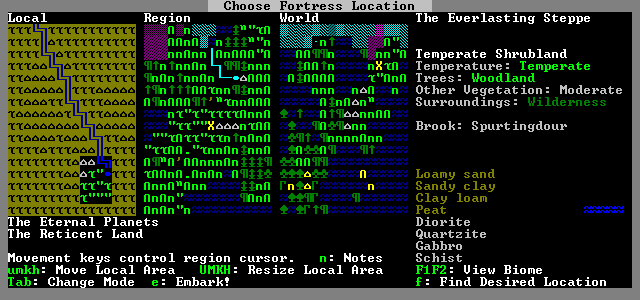
Dwarf Fortress has been around for most of this century and its influence upon both games as a medium and pop culture more broadly has been significant. Like Cave Story, there is little I can say about the game which has not already been said - even the MoMA saw fit to recognize DF during their first wave of video game preservation. It's provided inspirational thrust for the mainstream juggernaut that is Minecraft and the Hugo Award-winning Caves of Qud as well as spawning a number of DF-likes (perhaps enough to constitute a genre or subgenre). In this context, our focus is on Dwarf Fortress' ecosystem, and the intentionality with which its designers, Tarn and Zach Adams, seem to have encouraged the growth of said ecosystem.
I've elected to skip sleuthing through the Adams brothers' various blog posts, design logs and interviews to confirm their exact intentions when designing Dwarf Fortress and nurturing its community, and am instead going off of what I see on the game's site. From the linked Bay 12 website:
Bay 12 is dedicated to providing original games free of charge, but that doesn't mean it is free for us to make them. We've been online since December 2000, and you can help Bay 12 Games continue to thrive. If you've enjoyed any of our games, and you are able to give, we accept financial support.
While Dwarf Fortress brings in sizable income these days - especially since releasing a paid Steam version with sprite graphics, rather than ASCII tiles - for most of its two decades on Earth, it relied on tips, and you don't commit to twenty years of intensive development funded by tips alone without good reason. I suspect that Dwarf Fortress being a financially accessible experience is important to Tarn and Zach. Also notable are the links on the game page's navigation bar, about half of which link to the game's community, various community-made resources, transformative art based on DF, player-facing development diaries, and a portal for receiving player feedback. It seems reasonable to assume that a reciprocal relationship with an engaged community is also a pillar of DF's design strategy. Again, it's possible the Adams brothers have said as much, but this isn't a DF deep dive - I'm just skimming their webpage to make a point.
Said point goes like this: taking all of these things into account and holistically reverse-engineering them, I think a set of implied principles becomes quite clear. If we assume that the reason for designing around these principles is to ensure that a project as ambitious and esoteric as Dwarf Fortress reaches a sort of critical noospheric momentum threshold - that it turns from a quirky personal project into something that excites a community, nourishes minds, and keeps itself "alive" through a feedback loop of desire and creative engagement - these implied principles begin to look something like the infamous "integrated survivability 'onion.'"
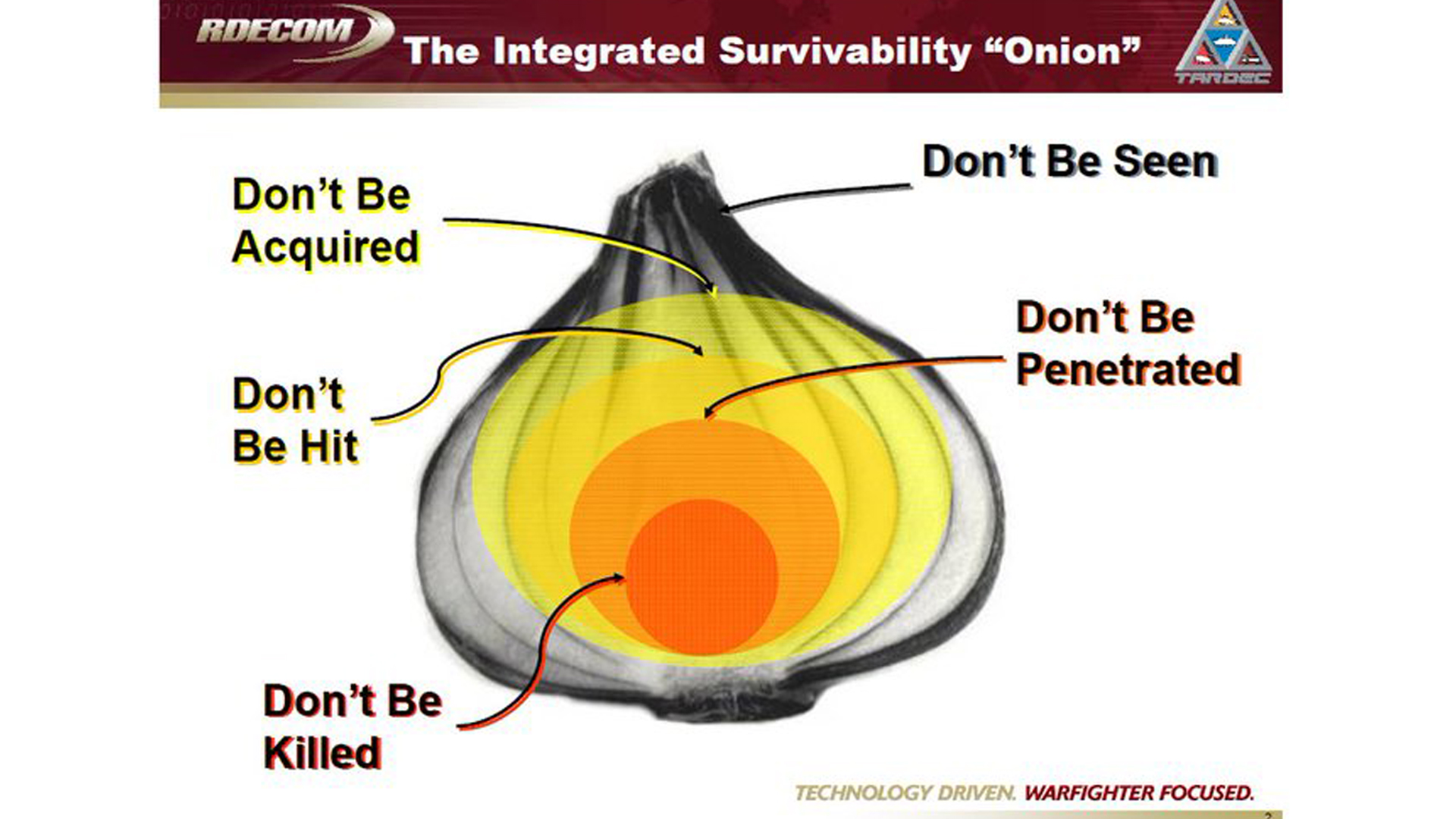
This goofy military model maps tank combat best practices to layers of an imaginary onion, with each layer towards the onion's core being a list item of increasing importance: don't be seen, don't be acquired, don't be hit, don't be penetrated10, don't be killed. To draw a chart towards the creation of games which foster and support gaming desire paths, we'll create a similar model called the "gaming desire path survivability pomegranate."
The pomegranate is also a list of items. Unlike an onion, these bullet points are not arranged in an ordered "if not this, then at least that"-style list. Instead, the bullet points are unordered "arils" of equal value - and the more arils you have, the gooder the pomegranate is. Observe:
The Gaming Desire Path Survivability "Pomegranate"
- Make it easy to document. Ensure that archival behavior is easy by providing access to prior versions of the game. Have somewhere you openly discuss your design process to create an environment of documentation, and support the creation of resource and guidance repositories, like wikis and directories.
- Make it easy to transform. Plan for and feed into players' desire to create transformative work. Leverage "sticky" properties of games like emergent storytelling and bleed/immersion, so that your game is tied in with personal expression and the telling of tall tales.
- Make it easy to transgress. Build the game so that it can be bent without breaking, and to break with grace. Allow, support, and champion modification and custom content. Modding tools and modular systems design are catnip for those players who are habitual creative transgressors.
- Make it human. Don't drive yourself crazy polishing out imperfections. Don't suppress your (or your team's) unique voice. Make something which sticks in the minds of the audience because of its idiosyncratic ambitions and uncompromising, personal design.
- Make it social. Create or encourage a community for the game, and regularly engage with it. Reward and facilitate contribution, especially contribution which falls under documentation, transformation, and transgression. Consider running group events.
- Make it free (or easy to distribute for free). Create the lowest financial barrier to entry you can afford. This can mean making the game literally free, or, if you cannot do that, choosing not to actively impede piracy with measures like DRM or guilt trip-based messaging.
You don't have to have all of these to make a good game, or even most or any of them, but the more you have, the more "survivable" your project is ("survivability" here meaning, roughly, how likely your game is to accrue a community and lodge itself in the tastemaking part of people's brains, rather than being lost in the churn or walled off as a paid experience). The more survivable something is, the less resistance it puts up, thus: YOUR GAME GETS INCLUDED IN DESIRE PATHS.
In the interest of putting my money where my mouth is, I'll briefly talk about how my own game, FIST: Ultra Edition, follows these principles in an effort to maximize its desire path survivability:
- Easy to document: FIST's layout and information design are oriented toward survivability in two key ways: the book is presented in black on white at US letter size, making it accessible to print and photocopy at home, and its gameable material uses natural language to express game mechanics wherever possible, while avoiding notation that cannot be expressed in Markdown. By eschewing complex color schemes, proprietary icons, and excess jargon, FIST maximizes ease-of-copying to a variety formats and platforms.
- Easy to transform: FIST uses multiple tactics to encourage self-expression through play, like aligning player and character goals, heavy use of emergent storytelling and fun based on "cheesing". Its setting is squarely anti-canon and steeped in hamfisted allegory, inviting the creation of OCs, fan art, and fan fiction with minimal constraints.
- Easy to transgress: FIST is built from the ground up for creative transgression. Its design is both aggressively modular and fundamentally concentric, built outwards in layers from a catch-all resolution mechanic. It's packaged with guidance for making custom content and de-emphasizes roadblocks like balancing wherever possible.
- Human: FIST is written in a casual, opinionated voice and does not shy away from idiosyncratic design and inspirations worn on its sleeve. The art is half plundered and half hand-drawn, frequently with process artifacts like sketch pencils and imperfect scanning left in the final product.
- Social: CLAYMORE has maintained an active FIST Discord server since about a year before Ultra Edition dropped, as well as running regular group events (mostly game jams) and frequent playtest sessions/campaigns open to community members.
- Free: FIST has always provided free-of-charge community copies and CLAYMORE is vocally pro-piracy, encouraging the FIST playerbase to use, copy and modify the rules however they like (specifically, FIST is licensed under CC BY SA 4.0, the same Creative Commons license as the SCP Foundation collaborative fiction project).
While FIST hasn't quite snowballed into an indie community phenomenon along the lines of something like Mothership (which combined a lot of right-place right-time exposure with established-company budget + knowhow, not to mention a clever third party licensing model that drew in indie devs looking to make a name for themselves professionally), I've been quite pleased to see these design principles play out as intended once the game was released into the wild.
As FIST: Ultra Edition approaches its three-year anniversary, the game's vibrant play culture has slowly but surely been laying the framework for a suite of tools for use with FIST's user-generated content corpus: the character-keeping Discord bot Sonder, the SRD and community content database at fistref.com, and 300+ missions, hacks, expansions, etc. on itch.io. We've also got nearly ten game jams under our belt, each with some absolutely stunning submissions, not to mention the occasional exciting oddity like FIST cosplays, FIST papercraft, and FIST sex mods. Some in the community have noted the startlingly high rate of FIST players who experience gender revelations after getting into the game. How many game designers get to say they contributed, in some small way, to an increase in the transgender population? Honestly, probably a lot of them, but it still feels good. Gotta get our numbers up, construct additional pylons.
On top of my belief that designing towards the free games ecosystem leads to a healthier and longer-lasting game, there is also a sentimental element at play. Creating a game with these principles in mind feels like somthing of a moral imperative. I owe so much of who I am to game designers and players who put in the time, effort and love necessary to feed the ecosystem that fed me. It was high time I gave something back.
Understand that the point of this piece is not to say that I believe those who work on games should not be paid, or that there is something wrong with you if you prefer that your own work not be modified or shared. I am too disabled for most careers; I live off of my game design income and I've spent most of my adult life as some flavor of homeless or underhoused, always at or below the poverty line. We do need to be paid for our work, we should be. Margins are slim in TTRPGs and decisions regarding what is paid and what is free cannot be taken lightly. Finding a balance between profit and financial accessibility is a tightrope walk and I am sure I have shot myself in the foot in ways I can't yet realize by steering away from design choices which might get people coming back to CLAYMORE alone for their FIST fix. It is what it is.
I also do not wish to imply that there is some inherent virtue in lacking access to paid media in one's formative years, or that I know all the coolest, most secret stuff on the web and have the most obscure and interesting taste a person can have - indeed, far from it. Nearly the opposite is true. I am often reminded just how lucky I am to know people with desires and paths far stranger than my own.
What I hope to get across is that the modes of self-expression and perpetual self-creation which a given person has access to - be they games, clothing, social spaces, whatever - are necessarily limited by that person's material conditions. The vast majority of people live in poor material conditions. The ability of that majority, when they engage with your work, to follow a path or paths of least resistance towards deeper engagement with the work, is one of the most critical factors in determining whether your game lives and dies in the claustrophobic box you birthed it in, or if it blossoms beyond your control into a garden of free and tastemaking desire.
I technically own a third pair of shoes which are some nice heels, but I can't just walk around in those without exposing everyone around me to an unhealthy dose of cunt radiation (plus moving about with a total operating height of 6'9" often gets me into altercations with doorjambs and light fixtures).↩
You're so smart. I love you. Dap into open mouth kiss.↩
"Thang Global" is also what I call my thang.↩
slayer64 was also a real one for uploading, at one point, his entire Game Maker projects folder as one big zip file. Almost everything I know about game design and programming I gleaned as a tween by digging through all that source code. No idea what happened to slayer64 nor can I find any information on him - one source says his name was Thomas Anderson, so I guess he's probably hanging out with Morpheus in Zion right now. Thank you for your ssservice, Missster Andersssonnn.↩
This one is particularly interesting for two reasons: it being an unlikely crossover between Manos: The Hands of Fate (plus its Mystery Science Theater 3000 episode) and Sega Genesis horror-themed beat-em-up Splatterhouse 3, and its being created entirely to fulfill the terms of a bet.↩
Somehow, Softpaz has the only copy in existence, that I am aware of, of a Mario clone game I made when I was in middle school. I distributed that shit on burned CDs, I don't know how they have it. Spine-chilling stuff - and to make matters worse, it's sitting at 2/5 stars according to the aggregate ratings of 63 people.↩
Doesn't matter who it is. They'll dogwalk me. Somehow, I wasn't born with the fighting game gene the rest of my people seem to have. Go figure.↩
Another epic chungus moment from Daniel D. Fox.↩
It's hard to keep up with the names women on 4chan are calling each other these days.↩
"Don't be penetrated"? Man, I can't have shit in this house!↩