On designer intentionality versus player control (and the perpetual creation of the self)
As per the suggestion of my excellent shrink Haley I have decided to make 2026 the YEAR OF PERSONAL EXPRESSION-RELATED ENDEAVORS. Despite my previous insistence that I am a normal person and everyone experiences their life via scant flashes of lucidity between amnesiac nothing-gaps which span a number of years, it is Haley's professional opinion that I suffer from depersonalization-derealization disorder, or DPDR. Who knew! Certainly not me - or, maybe I did know and had been repressing it. The human mind works in mysterious ways. In any case, that's not my job to figure out - that's what taxpayers pay Haley to do.
My original homework was to ground myself in reality by drawing things that I see, which quickly spiraled into drawing autobiographical comics. Since I responded positively to creative therapy, Haley suggested letting myself be more creative. "That's odd," I had thought, at the time. "I'm already a creative person. In fact, my whole job is based on my creativity - I get paid to write, lay out, and illustrate tabletop roleplaying games." But games are a tricky medium, aren't they, because they are participatory, and like any participatory medium there is a necessary tension between the intentions of the author and the direction chosen by the audience. When it comes to TTRPGs this is doubly true.

It has always been my opinion that TTRPGs are not so much an art, i.e. a vehicle for creative expression in and of themselves, but rather a craft, i.e. an exercise in the skillful creation of a platform, tool, or accoutrement. Art is for me, craft is for you. From this point of view a game ought to be a functional entertainment product and it ought to be commercially viable. From my consulting writeup for Ben Tobitt's Zero Hour:
Commercial appeal is a controversial choice of priority in RPGs; a lot of us think of indie RPG developers as artists, not entertainers or producers of a product. There is obviously value in a game that is a raw expression of art, but I've found Rolltop Indigo's Five Elements of Commercial Appeal in RPG Design extremely useful in getting projects off the ground. Commercial viability and creative success are also more entwined, I think, than a lot of us would like to believe. A game that no one wants to buy is a game that does not spawn a community. It does not draw in other creatives to riff on it and create material for it, and if no one plays it at all, it fails at being what RPGs fundamentally are - that is, vehicles for players to express themselves. Our desires for expression, as designers, take a back seat. We provide something that is easy to talk about, convince one's friends to play, and use as fodder for one's own ideas. That means that we may find ourselves having to "kill our darlings" and cut or change creative choices we like in the interest of appealing to a wider range of people.
It is what it is. If you just want to express something, rather than design a toolkit for others to express something, don't make a game - write a book.1 That's been my take for the last five years. Lately though I've begun to second-guess my strongly held opinion that designer intentionality should take a back seat to player control. Maybe players, God love them, should sometimes be forced to sit down, shut up, and tolerate the choices of a designer who has a purpose and strategy in mind for the piece they are trying to create. Enter 2002 survival horror classic Resident Evil.

This remake of the original Resident Evil changed the trajectory of my taste when I played it in my late teens. Never before had I played a game with tank controls, fixed camera angles, surreal puzzles which strain believability, an almost user-hostile save game system, and other such staples of early survival horror. I can recall my time playing it ten years ago as vividly as it were yesterday, which is saying something considering most of my life before my twenties is a blur. It's an experience that's just transcendent, a game that reaches for inspirations and feelings beyond its own medium2 and knocks its atmosphere, its aura out of the park by restricting player control.
This month I've come back to REmake as my bestie and I mount an effort to tizz out3 together about the Resident Evil series. I'd been trying to get her on REmake for years with no luck; the tank controls had proved too clunky, the fixed camera angles too unusual and restrictive, the save system (which limits the amount the player can save their progress by tying saves to ink ribbons, a consumable item) too nerve-wracking. Luckily for my friend, the HD port of REmake allows the player to use "modern" omnidirectional controls that let Jill and Chris move 'round the map deftly as Doomguy, and all subsequent remakes of the older Resident Evils past the first ditch the fixed camera angles in favor of a more modern, player-friendly, over-the-shoulder third-person-shooter camera setup. For some reason I couldn't articulate, these toggleable conveniences and modernized adjustments didn't seem right to me. Weren't they doing something to undermine, even obliterate the design choices which made Resident Evil and its first few sequels special? Maybe, in this case, the customer wasn't always right.

"You've got to play the OG fixed-camera Resident Evils with tank controls," I had insisted. "And the save system is great - it's supposed to make you nervous. You have to sit down and play with intention. You have to constantly wonder if you've accomplished enough to justify spending an ink ribbon to save your game. I'll sit down and play through the beginning with you until it clicks. I promise it's worth it."
And it did click! After some grumbling from her and proselytizing from me, the way these design decisions sing in harmony with each other began to make itself clear. Suddenly Resident Evil began to bounce, spin, and even do tricks on it a little, impressing us with its mastery of mise-en-scène, a French filmmaking term which means "vibes."
If Resident Evil let its player control the camera angle, it couldn't unsettle with its Dutch angle shots of too-long hallways, dazzle with its wide shots of mansion foyers, delight with its clever use of leaned-up mirrors and cast shadows to imply threats, unnerve with its peeping Tom shots from beneath tables and above chandeliers.
If Resident Evil didn't force clunky tank controls upon its player, it couldn't immerse them in the unique experience of watching one's avatar slowly back up in horror or struggle to navigate a tight space.
If Resident Evil didn't restrict when, where, and how much its player can save their progress, it wouldn't be able to convey the unique, gut-sinking feeling of being scared to turn the game on and unsure when it's okay to turn it off. It certainly wouldn't be able to evoke such a feeling of genuine relief when a save room is found (although the excellent soundtrack doesn't hurt).

Throughout Resident Evil are the hallmarks of a designer or group of designers who have decided that their intentions are more important than player control. It could be argued that some of these choices are also due to hardware limitations, but considering the concurrent existence of the Metal Gear series, which (in addition to having modern directional controls and unlimited, always-available saving) had opted to supplement its fixed-camera approach with a first-person mode that only got more robust and player-friendly between games, I do not think REmake's anti-player control design choices can be chalked up to necessity alone. There is a tension between designer intentionality and player control that makes 2002's Resident Evil what it is. Unlike Metal Gear Solid 1 and 2's constant effort to blur the line and create "bleed" between the player and their onscreen avatar, REmake wants you to know that, while you are meant to enjoy yourself as you play, it's Shinji Mikami (and his design team)'s world - you're just living in it.

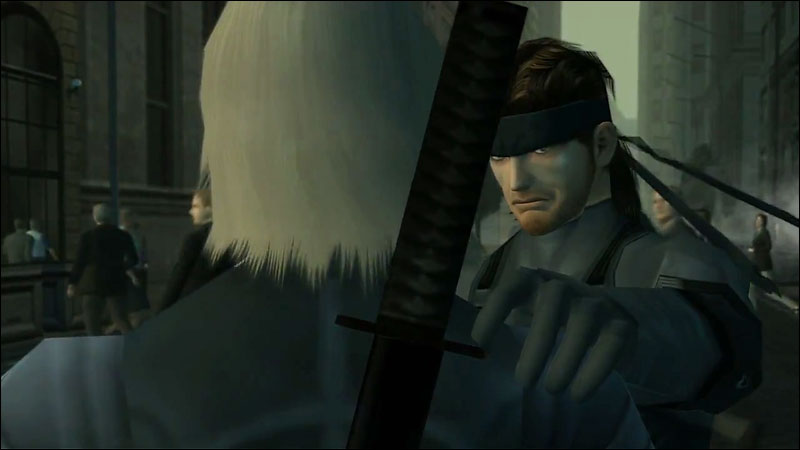
In contrast, Metal Gear Solid 1 and 2 are all about Hideo Kojima (and his design team) trying to claw their way into your world and live in it. Beyond literal bleed-tricks like hearing in-fiction characters verbally describe button inputs, or tell you about other games you've played, or insist they are actually moving your controller, the Metal Gear games want to mold the player's sense of self and push it in a new direction. They are willing to give you the fullest control over the camera possible which the hardware of the period affords so that you feel immersed, they are willing to stop the game dead and preach to you about real-life issues, they are willing to engage in meta-plots about being a gamer playing a video game, all in service of focusing on the player's self. That's not to say that the designers' preoccupations, fixations, and political beliefs don't make their way into Metal Gear - the opposite is true, infamously so - but MGS is so into the idea that the player ought to be considering their own story, building their own self, that Solid Snake just about beats you over the head with a brick about it at the end of the second installment.4
Applied to TTRPGs, this tension between designer and player looks a lot like the oft-reheated "does system matter" debate - but that debate doesn't interest me because it strikes me as a false dichotomy standing in the way of a bigger, deeper issue in game design. Does this make me a better, more intelligent designer than everyone else? No.5 But it does give me a different perspective: some games are all about the designer's PERPETUAL CREATION OF SELF, and some games are all about the player's PERPETUAL CREATION OF SELF.
I struggle with having a "self." I couldn't describe to you what I am like, or what I have been like. I strain to put together a timeline of my life as though I were one, contiguous conscious being. But I do know - or at least feel in my bones - that the self is an emergent property of consciousness, and it is something that is always happening more than it is something that just is. The self is PERPETUALLY CREATED.
With this in mind, we can approach TTRPGs from an angle perpendicular to whether system does or does not matter. We understand as TTRPG designers that we are creating in a participatory medium and do not control how players engage with the stuff we write. We could think that system really matters and clutch our pearls when a table hacks our finely-tuned Swiss watch of a game into something unrecognizable as though they know better, or we could think that system doesn't matter and make the most flexible, malleable toolkit possible for a table's personal expression only to find that the poor saps spend half the session bickering about how to follow our rules exactly as written. What we can control is whose PERPETUAL CREATION OF SELF we are contributing to: ours, or theirs.
Do we design a system that gets out of the way at every turn so that players may create their selves in our sandbox - one which leverages concentric design, rulings-not-rules mentality, and robust homebrew support to create the Garry's Mod or Minecraft or Skyrim of tabletop RPGs, something that begs to be hacked and modded, bent and broken, chewed up and spit out in the name of transgressive play? Or do we write something that's all about us, which splashes our specific idiosyncrasies and highly personal decisions onto the page and demands that the player live in our world for a while, understand what we're talking about and why? In either case we will include slivers of our heart, bake in our politics and our taste and our interests and push them upon the audience, because avoiding that is necessarily impossible, because avoiding that means avoiding authorship - but who do we prioritize? Is TTRPG design a craft for the enrichment and construction of you, or an art for the expression and apotheosis of me?
A year ago I would've said: always the former. Designer intentionality takes a back seat to player control. "If you just want to write something, write a book." Now that I've found myself arguing to my poor friend that simply toggling off a designer's decisions is artistic sacrilege, I'm not so sure.
You could also write a lyric game. Lyric games do not appeal to me personally because a game that cannot be played fails to be a game fundamentally. I think if I painted a painting that could not be viewed, or filmed a film which could not be watched, and presented it to you, you would lay my ass out and rightfully so - but that is just my opinion and I do respect the right of all people to make whatever they want, lyric games included. Hell, I even like some of them.↩
The 21st century AAA video games arms race to make "more cinematic" experiences isn't relevant here - any work of art is improved by pulling from a diverse range of media, instead of just being about its own medium and contemporaries.↩
Develop an autistic special interest in.↩
If you were an insane person, you could say that Metal Gear service tops, and Resident Evil power bottoms.↩
Yes.↩